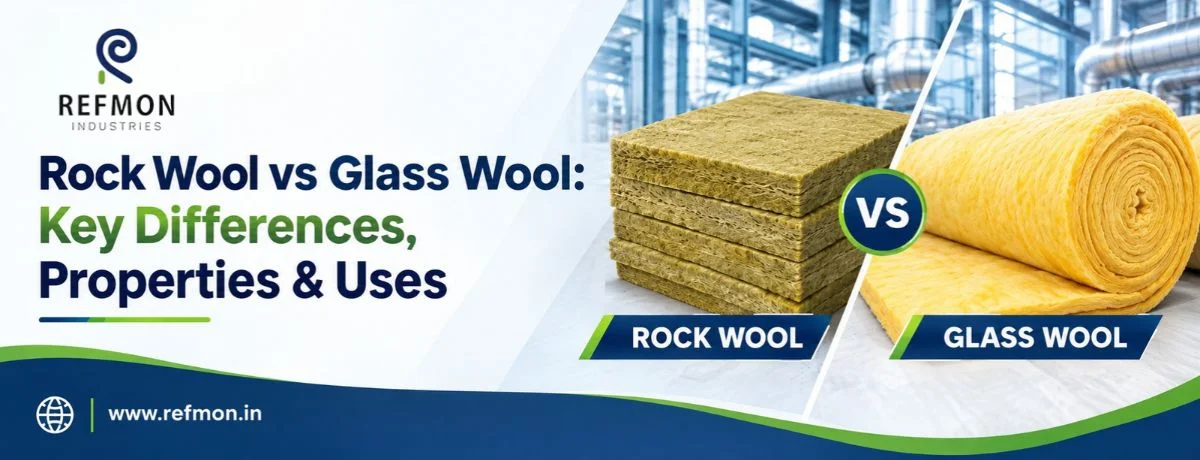
Rock Wool vs Glass Wool: Key Differences, Properties & Uses
Selecting a suitable insulation material can affect the thermal control, energy efficiency, safety, and durability of industrial equipment. Common materials are rock wool and glass wool. Both can cut down on heat transfer and provide sound insulation. But, they vary in composition, tolerance for heat, weight and typical use.
Understanding the differences can help you choose the appropriate material for a system. Glasswool insulation is light weight and more popular for most building, HVAC, and industrial projects. In contrast, rock wool insulation is preferred for projects that require a higher degree of fire resistance or higher temperature projects.
What Is Rock Wool?
Rock wool is a type of mineral wool insulation made by melting natural rock and mineral raw materials and converting them into fibers. The bonded fibers make a variety of insulation products, including blankets, slabs and pipe sections.
Rock wool is non-combustible and highly resistant to high temperatures. It is often applied to hot pipelines, equipment, tanks, furnaces and boiler areas. LRB mattresses are also used in industrial applications where insulation requirements can withstand high operating temperatures. Some rock wool LRB insulation products are designed for high-temperature applications with the maximum service temperature depending on the specific product and manufacturer specifications.
What Is Glass Wool?
Glass wool is made by converting molten glass into fine fibers. These fibers retain air, which slows heat transfer. This material is light and can be delivered in rolls, boards, blankets and more.
Glass wool is used for both thermal and acoustic insulation. It is used in pipelines, furnaces, boilers, HVAC systems, walls, ceilings, and roofs. The applicable temperature range of glass wool varies by product, construction, binder, and manufacturer specifications.
Rock Wool vs Glass Wool: Main Differences
| Property | Rock Wool | Glass Wool |
| Raw Material: | Rock and mineral fibers | Glass fibers |
| Weight: | Usually heavier | Generally lighter |
| Heat Resistance: | Suitable for high-temperature applications | Suitable for moderate temperature applications |
| Fire Performance: | Non-combustible and highly fire resistant | Generally non-combustible, depending on the specific product |
| Sound Insulation: | Superior sound absorption | Good sound absorption |
| Common Forms: | LRB mattresses, slabs, pipe sections | Rolls, boards, blankets |
| Common Uses: | Furnaces, boilers, tanks, hot piping | Buildings, HVAC, roofs, ceilings, pipelines |
The selection depends on the working temperature, installation space, required thickness, density, fire and physical conditions of the equipment. No one insulation material is ideal for all applications.
Where Is Rock Wool Used?
Rock wool is often preferred in industrial areas with high temperatures. It is excellent for boilers, furnaces, hot vessels, tanks, ducts and piping systems.
Rockwool Hot LRB Insulation is particularly useful in industrial systems where hot equipment and piping need insulation. LRB stands for Light Resin Bonded. These mattresses consist of rock fibers and are often woven and matted with wire mesh for attachment.
Where Is Glass Wool Used?
If you need lightweight insulation, you can use glass wool. It is suitable for installation in industrial sheds, HVAC ducts, building roofs, walls and ceilings, and in some pipeline applications.
Its fiber also absorbs sound, so it can be used in offices, auditoriums, studios, commercial buildings, and other spaces that need noise-absorbing properties.
Choosing the Right Insulation Material
The first question to ask is the operating temperature before choosing rock wool or glass wool. Insulation location is also important. The properties of a material used on a hot pipeline can differ from those used inside a building wall.
Other considerations are moisture exposure, fire protection, mechanical protection, thickness, density, installation and maintenance. Select insulation products according to pipe temperature and service conditions.
Select products that meet the required specifications rather than choosing solely on price. Different insulation manufactures in India, such as Refmon Industries, offers insulators options with different densities, thicknesses, shapes and temperature ranges. By checking the technical specifications before you buy, you can avoid heat loss and installation problems.
Conclusion
Rock wool and glass wool are both thermal and acoustic insulators but with properties for different uses. Rock wool is used primarily in industrial systems at high temperatures because of its thermal performance, non-combustibility, and fire resistance. Glass wool is lightweight and widely used in HVAC systems, roofs, ceilings, building materials, and some industrial applications.
Choose it on the basis of temperature, place, safety factors, product specifications and installation site. In high-temperature industrial systems, properly designed hot insulation in piping helps minimize heat loss from transfer lines connected to refractory-lined equipment.